For workers and companies

Simplifying cross-border employment

Euradria contributes to improving employment in the cross-border region between Italy and Slovenia and aims to increase employment opportunities for workers as well as facilitating the recruitment process for employers.

Immagine decorativa: Simplifying cross-border employment

EURADRIA cross-border labour market data collection: an overview

EURADRIA partnership activities include the data collection within the cross-border labour market.

As for the data collection related to the observatory activity, it’s important to underline that the data collection has been considered, starting from 2020, as an adaptive measurement practice useful to acquire more precise data on CB LM and to give a more extensive view on the composition and the dynamics of our CB panorama, including both jobseekers/workers and employers within the CB area, the other organisations and the relevant emerging activities, not forgetting the wider panorama to which the CBPs activities, scopes and objectives are strictly connected.

Therefore, the current analysis involves both quantitative and qualitative indicators, as statistical and contextual elements, with the intent to connect different tools, responsibilities, strategies and activities deriving and coming from multiple levels.

  • Data collection targets the cross-border region including the region Friuli Venezia Giulia in Italy (NUTS2 ITH4) and the statistical regions of Goriška (NUTS3 SI043), Obalno-kraška (NUTS3 SI044) and Notranjsko-kraška (NUTS3 SI038) in Slovenia within its boundaries
  • Data collection is carried out by semesters, including the first and second semesters of each calendar year.
  • Data collection is carried by each participating Organisation on the basis of its specific competencies and role within the cross-border labour market.
  • Data collection is carried out by aggregating relevant information collected through onsite and online activities of the Infodesks active within the CB area, managed by Public Employment Services & EURES territorial networks, Associations of Employers, Trade Unions & Patronages.
  • Data collection includes indicators on Jobseekers, Workers and Employers.
  • Data collection focuses on a set of EURES-aligned relevant topics, as Placement, Taxation, Social Security, Living & Woking conditions, Education & Training, Additional guidance.
  • Data collection for Cross-border partnership includes, within the EURADRIA region, data on Vulnerable people in respect to Labour Market access, Specific cases and persisting obstacles, Telework, EU citizens residing in other bordering Countries as AT and HR and/or in other EU Countries, Migrants as 3rd Countries Citizens/CB residents and/or other Country residents), Requests of cooperation & Partnerships. 
  • Data collection includes indicators related to Cross-Border Communication & Dissemination activities and Events as informative, recruitment, mixed, Customer Satisfaction.
  • Data collection includes both quantitative and qualitative data. To this end, an Annual Report on data is part of the data collection activities, under the EURADRIA Cross-Border Observatory.

EURADRIA considers the PMS for CBPs as a flexible tool used to trace and detect the specificities within the targeted area. The tool evolved coherently to the evolution of the CB LM conditions, including standard data requested by the EC level and other data considered as relevant within the specific territory and related to a few emerging topics, also connected to the major EU challenges and priorities.

Therefore, within such panorama the EURADRIA PMS for CBPs is constantly subject to revisions and adaptations, to enhance its potential to better detect the needs and the requests coming both from the partners, staying aligned to the labour market needs and specificities at internal and EU level and to the emergencies faced after the CoViD-19 sanitary emergency and other relevant changes within the CB LM and the areas targeted by the project (e.g. Ukrainians under temporary protection, migrants, vulnerables, undeclared,…).

It is considered as a responsive analytical tool, already integrated within the risk and crisis management strategy.
 

Brief methodological note:

the data are gained through the Infodesks activities and the public channels and tools managed by EURADRIA, as PES, Trade Unions, Patronages and Associations of Employers.

The attention of the CBP is focused on those frontiers specifically moving within the area for working reasons. Therefore, our panorama of users, detected mainly through the Infodesks located within the area, is made by jobseekers within the CB area, workers already employed within the CB area, employers whose premises and/or activities are carried out within the CB area, users want to relocate within the CB area. The numbers detected by the Infodesks are therefore related to the users still in need of overcoming an obstacle and/or in any case in need of support within the CB area. Support is therefore intended as job searching, social security and taxation support, recruitment, general information on CB area.

Since 2019, considerable progress has been made in the census of employers and jobseekers/workers, however there are still some difficulties in tracing precisely some elements and indicators. A process to implement a more punctual and effective methodology to allow the timely recovery of such data already started and it will be consolidated through the next future project actions.


Overview on the CB area:


EURADRIA Cross-Border partnership Italy-Slovenia
ITALY SLOVENIA
Regions involved Friuli Venezia Giulia (ITH4) Goriška (SI043) Obalno-kraška (SI044) Notranjsko-kraška (SI038)
Population 1.194.616 118.421 118.426 53.400
Economically active pop 549.9 (Unit:1000) 503 (Unit:1000)
Official language/s Italian Slovenian
% of Active Companies/businesses: small, medium, large, micro § Micro-enterprises (up to 10 employees): over 93.5%;

§ Small enterprises (11–49 employees): over 5.7%;

§ Medium (50-249) and large enterprises (+250): approximately 0.8%

§  Micro-enterprises (up to 10 employees): over 95%;

§  Small enterprises (11–49 employees), Medium (50-249) and large enterprises (+250): approximately 5%

Pop average age 48.6 44.5
Gender distribution Females: 51.1%;

Males: 48.9%

Females: 49.8%;

Males: 50.2%

Average cost of life (monthly costs per single person) €1,600–€2,300 €1,300–€1,500
Average monthly salary (gross) ~€2,900 – €3,000+ (net: ~€1,600 – €1,800+)

Income tax and social contributions: typically, Italy’s combined tax + social security deductions on gross salary range from 30% to 40% for average earners.

~€2,500 – €2,790 (net: ~€1,600 – €1,760)

Income tax and social contributions: Slovenia’s deductions can be around 25–30% combined for typical middle incomes.

CB most represented NACEs

A: Agriculture, Forestry and Fishing, including seasonal activities;

C: Manufacturing, including Maritime/Naval/Shipbuilding;Mechanic/Mechatronics;

F: Construction;

M: Professional, Scientific and Technical Activities;

J: Information and Communication, including Science &Innovation, ICT;

I: Accommodation and Food Service Activities and R: Arts, Entertainment, and Recreation;

Q: Human Health and Social Work Activities;

CB area total inhabitants

1,500,000 inh.

CB estimated number of frontiers

12.000

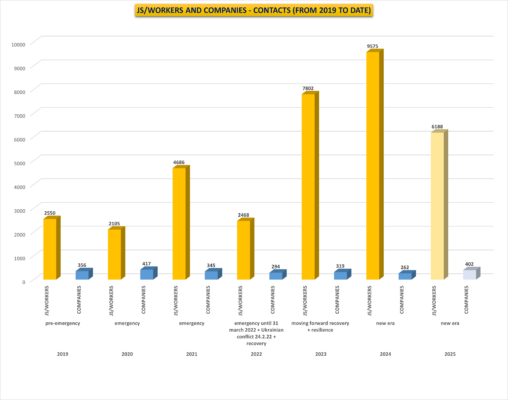
COMPARISON BETWEEN JOBSEEKERS/WORKERS AND COMPANIES:

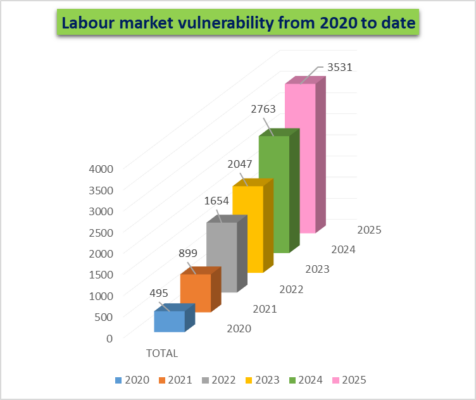
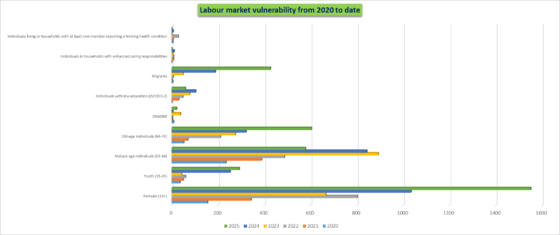
VULNERABLES:

here below an overview on how data increased from 2020 to 2025. The breakdown has been made by Categories.

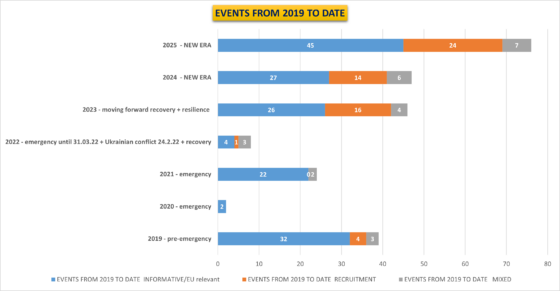
EVENTS

events are classified as Informative, Recruitment and Mixed. As said, here also a major systematization is currently ongoing, as a useful data collection specifically related to Communication and Dissemination major issues, besides that an indicator contributing to measure the effectiveness of a specific set of actions.

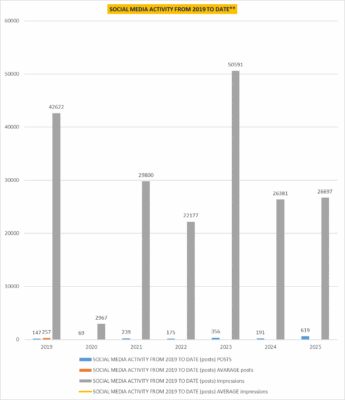
SOCIAL MEDIA ACTIVITIES:

social media activities continue to be a relevant part of the major strategy on Communication and Dissemination. Here also is possible to give a brief overview on trends from 2019 to 2025, specifically related to the number of Posts and to the number of their reaching (Impressions/views).